Jackie Bradwell Jackie Bradwell
Hearing Aid Audiologist
and Manager

Let me call you back

Leave me your details and I will call you back

Name:

Email Address:

Phone Number:


Selecting the right hearing aid

Behind the ear - hearing aid

In the ear - hearing aid

In the ear - hearing aid

In the ear - hearing aid
Bone COnductin g Hearing Aid

DIgital Hearing Aids
Good advice from our audiologistsSelecting the right hearing aid

Hearing Aid Types

About Hearing Aids - Expectations

No matter what you have heard about hearing instruments, none of it matters until your own ears are in question. Then, nothing is more interesting than learning all there is to know about these emotionally and electronically loaded little devices: the aesthetics, the size, the microchips, the bells, the whistles, the possibilities, the costs, the success stories.

By understanding some of the differences between hearing aid styles you and our hearing aid audiologists will be able to select the device that is right for you, your life style and your budget.

Selecting the Right Hearing Aid for you

The range of hearing aids offered by Knutsford Hearing Centre are custom-made and individually manufactured so that they fit the shape of your ear exactly.

It is worth reminding you that, as an independent hearing aid centre, we can source devices from ANY manufacturer enabling us to find the right solution for you.

Here are the main hearing aid styles on the market today


Generally, hearing aids can be classified into seven different types in terms of how they are fitted, how they work and what benefits they offer. Here is a brief overview of each type of hearing aid including who they may be suitable for.

Behind-the-ear (BTE)

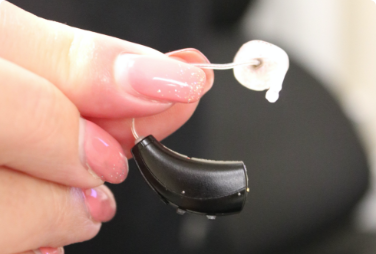
This hearing aid sits behind the outer ear and connects via a plastic tube to a custom made earmould that sits in the ear canal and delivers sound into the ear. Some models have directional microphones.

* Easy to maintain
* Appropriate for most types of hearing loss
* Secure fit with minimal passageway obstruction

In-the-ear (ITE)

ITE hearing aids sit in the outer ear (the working parts are all contained within this earmould) and may be used for a variety of hearing losses.

* Easy to insert and adjust
* Appropriate for mild to severe hearing loss
* Custom-made shell fits snugly in ear

Receiver in-the-canal (RIC)

Receiver-in-the-canal (RIC) devices are designed to widen the distance between microphone and receiver, thereby lessening feedback.

* Offers a discreet open-fit solution
* Appropriate for mild to moderate hearing loss

Completely in-the-canal (CIC)

Smaller than ITE aids, CIC hearing aids sit right in the ear canal and are less visible, but are generally less suited to more severe hearing losses.

* Nearly invisible for complete discretion
* Appropriate for mild to moderate hearing loss
* Used in adults exclusively

Body-worn

Body-worn hearing aids consist of an earpiece connected by a lead to a small box that can be attached to clothes or placed in the pocket. Some people find the controls easier to handle and they can be very powerful.

Bone conduction


For people with a conductive hearing loss and those who cannot wear conventional air conduction hearing aids.

CROS/BiCROS

For people with hearing in only one ear, the CROS aid picks up sound from the side with no hearing and feeds the sound to the ear with normal hearing. BiCROS aids work in the same way but amplify the sound for people with no hearing in one ear and some hearing loss in the other ear as well.

Disposable

These hearing aids are replaced when the battery runs out and usually last about 10 weeks. Useful for people with mild to moderate hearing loss.

Digital Hearing Aids


The new digital hearing aids are revolutionizing the way hearing aids work

Digital technology’s superiority over traditional analog hearing instruments isn’t just what it can do with sounds, but how much better it does it.

By converting the incoming signals into computerized ‘bits,’ they can be processed, or manipulated extremely fast and efficiently in many complex ways.

This gives digital signal processors (DSP) tremendous speed and agility to recognize sound’s key ingredients and feed them right to where they matter... to you!


© 2009 Knutsford Hearing Centre Ltd